Tactile Café, very specialty coffee
By Pomélo
(c) Tactile
With Tactile, opened last March in the 11th arrondissement of Paris, Pierre de Chanterac, a French figure of specialty coffee, defends a model apart: a coffee shop that one does not visit only for a coffee to take away, but where one comes to sit down, taste, discover. A place where questions are asked, which rarely go unanswered. An address thought as a place to taste, demanding but far from being intimidating.
Entering Tactile’s place is almost like entering a neighborhood house. There is the old parquet floor, which sings in the footsteps of customers, the coffee chairs curved with black, the mirror, the menu hand-painted, all these details that suggest a historic address, yet it has only existed since last March. Yet, behind this familiar setting, everything speaks of specialty coffee: the custoized water, the mills chosen to the millimeter, the cups designed for each use, the coffees preserved as in a cellar... Pierre de Chanterac, world champion in the Czeve/Ibrik category of coffee in 2023 (a traditional method of preparing coffee that is very popular in the Balkans, Turkey, and the Middle East), did not want to open another coffee shop, one too many, but an address where coffee is drunk with the seriousness of a great product and the simplicity of a moment at the counter.
"I am a host", Pierre de Chanterac sums up. This is perhaps the best way to understand Tactile. Here, the barista’s job is not limited to producing a fair cup, it consists in welcoming habits... and resistance. Specialty coffee still retains, for many, the image of a world too acidic, too expensive, Pierre knows. He does not deny the acidity of his coffees, on the contrary. He works with high-end coffees, often marked by an aromatic complexity and a fruity tension. But its principle remains simple: "a good coffee is an easy-to-drink coffee." If it bothers, due to bitterness or acidity, something goes wrong.
To achieve this softness, Tactile went very far with the equipment. The mills come from Weber Workshops. A system is used to demineralize the water, then remineralize it according to the uses: espresso, filter, milk drink. To this are added adjustments with the drop, literally, with mineral concentrates, to approach as closely as possible the desired balance. This is not a technician’s whim, it’s the invisible back kitchen. This attention to detail, Pierre owes it to his background as a trained cook, he notably went through the gastronomic restaurant La Chèvre d'Or** on the Côte d'Azur.
This precision does not stop at the café. The boss presents Tactile as a place mainly dedicated to liquids of excellence. Hot chocolate is available with water or "à la parisienne", rounder and creamier, without the heaviness of a classic tea room chocolate. The matcha comes from a very thorough sourcing. The chai is based on a spice base and an oleo saccharum of infused tea leaves, vacuum-sealed for 96 hours to gain complexity.
This obsession is aptly named after the place. Tactile, because here tasting also happens by hand. The coffee cups were custom-designed by Loveramics. The filter cups were designed and painted by hand. Some people wear braille. The ibrik, on the other hand, doesn’t have to be taken away: it is served in a cup designed to hold back the marc. Even toilet soaps extend the experience, with scents imagined around certain coffee regions.
There is still a logical question: can such a model work? Pierre does not mask reality: Tactile is not yet profitable. Craftsmanship is expensive, and time spent explaining it is too. In a classic coffee shop, the economic base often relies on slats to take away. At Tactile, the experience is more oriented towards the destination. We come with an address registered in our phone, we sit down, we taste several drinks, sometimes we choose a cellar coffee, kept at -20 °C and prepared to order. The average ticket is necessarily higher -about 17€ against 7-8€ in a classic coffee shop- but the recurrence is not the same.
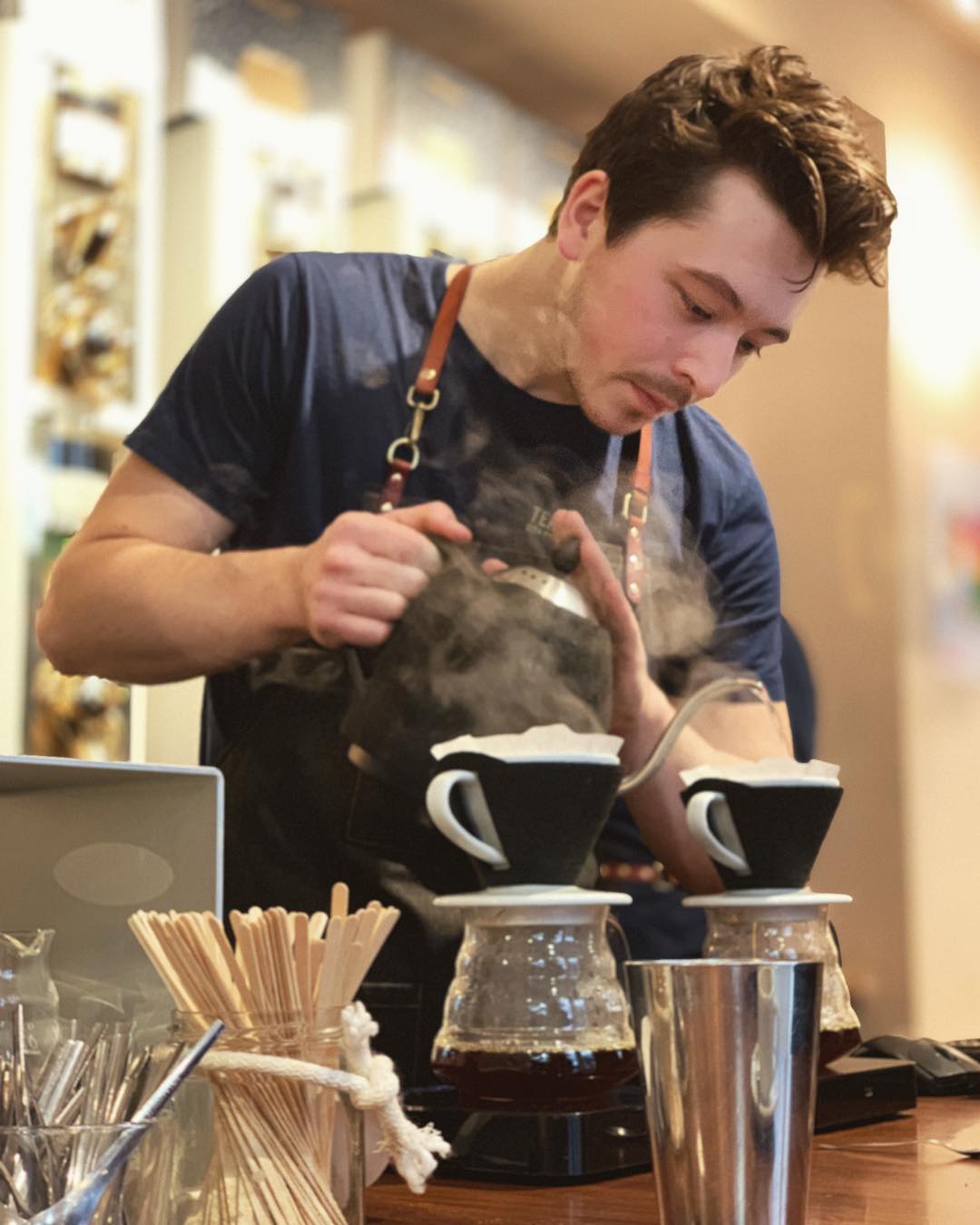
It is precisely on this point that the project is interesting for contemporary restoration. Tactile seeks to demonstrate that a coffee shop can go beyond the sole logic of the flow. That it can become a gift, a stop, an experience almost comparable to a wine or chocolate tasting. Pierre already imagines gift cards, premium cups, rare coffees, and cocktail formulas. He knows that the clientele will be partly international, made up of travelers capable of looking for the "best" coffee shop in a city as one seeks a restaurant or a bar.
What makes Tactile endearing is that this global ambition does not translate into laboratory coldness. The place remains anchored in a corner of the 11th where the food ecosystem circulates, between Septime*, Jones and neighborhood addresses. Every day, it welcomes baristas, pastry chefs, mixologists, but also customers who simply come to enjoy "a coffee". To those, Pierre does not lecture. He serves, explains if necessary, reassures if they dare -sacrilege- to ask for sugar. There isn’t any on site, but it’s possible to go and get some pods of sugar from the bakery across the street.
Pierre could have built a place for initiates. He preferred a place where you can enter without instructions, order coffee, ask questions or even not ask any. "A good coffee is an easy-to-drink coffee," he repeats, like a credo.
Tactile Café, 164 avenue Ledru Rollin, 75011 Paris